For a long time, the cart-path-only golfer was an afterthought in the product world. The marketing photos showed walkers, striders, rangefinders raised from the fairway. The reviews assumed you had line of sight, full mobility, and time to stand over your ball. If you were on the cart path — because the rule said so, because your back said so, because the pace of play said so — you were on your own. The product experience was a yardage guess and a shrug, and most of the major brands in golf were not interested in solving it.
Cart-path-only rounds have grown as a share of total rounds over the last decade, driven by aging player demographics, health considerations, pace-of-play pressure at busy public courses, and a slow decline in walked rounds at clubs that have historically encouraged walking. The audience is no longer a niche. It is a substantial slice of the recreational market, and the product experience for that audience has not caught up to the size of the audience.
The first generation of “cart-path solutions” were mostly repurposed fitness GPS watches. They worked, sort of, but they were designed for runners, not for golfers. The voice prompts fired late, the screens washed out, the hazard yardages were missing, and the GPS coverage was generic.
I have been testing cart-path GPS speakers for four seasons, and the units that have come across my bag have mostly been underwhelming. The shift in the last year is real. A few smaller players have stepped into the gap that the major brands left, and the products they are putting out are noticeably better than what came before.
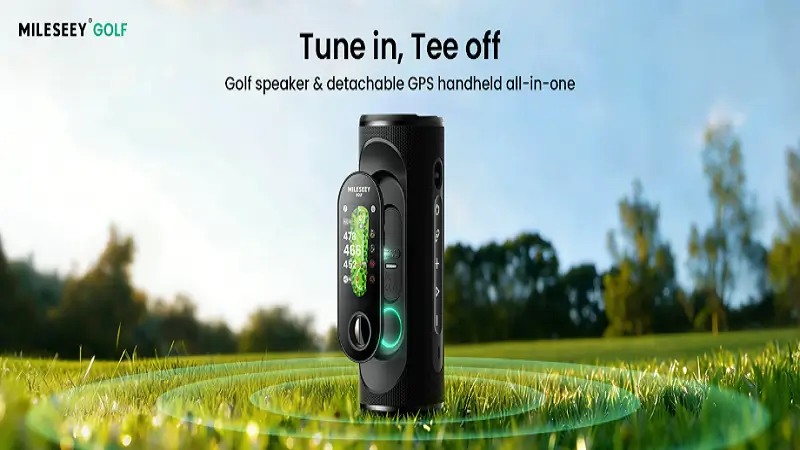
The second generation is meaningfully better, and I’ve been testing one of the more interesting entries, the Mileseey GeneSonic Pro golf GPS speaker — a Red Dot Design Winner 2026 — which is the world’s first all-in-one: a 40-watt golf speaker with a detachable 3-inch touchscreen GPS handheld. The product positioning is “GPS speaker for cart-path golf.” That’s a narrow brief, but it is a real brief, and most of the category has been ignoring it.
What a Cart-Path Speaker Actually Has to Do
The job of a cart-path GPS speaker is to give you the numbers you would have gotten from a rangefinder, without you having to step off the cart, walk to your ball, and walk back. In a typical cart-path-only round, you do this 14 times. If each interruption costs you 90 seconds — walking, clubbing, walking back, hitting — that is 21 minutes of round time. More importantly, it is 14 moments of cognitive overhead, 14 decisions about whether to walk or to guess, 14 compromises in club selection.
A good cart-path speaker collapses most of that. The unit sits in the cradle, talks to the GPS, and speaks the yardage to the front, middle, and back of the green as you approach your ball. You listen. You walk up. You club. You walk back. You hit.
The job sounds simple. The execution is hard, and most products fail at it. The GeneSonic Pro is the first unit I’ve tested that does the four things that matter — voice timing, audio clarity, hazard yardages, and a mounting system that does not break — at a level where I would use it as my primary yardage source on a cart-path day.
The 40-Watt Sound Is the Real Story
The single biggest complaint about every cart-path speaker I have tested is that the audio is too quiet. A 15 mph headwind, a cart engine, and a foursome talking will swallow a quiet voice. The GeneSonic Pro is loud. Genuinely, impressively loud. 40 watts of audio, engineered with a dual-band crossover system, a silk-dome tweeter, a racetrack woofer, and dual passive radiators. The voice prompts are clean and intelligible. Music, when you play it, has real bass response, not the tinny mid-range you get from a clip-on speaker.
The detachable 3-inch touchscreen GPS handheld pairs with the speaker over Bluetooth. Tap the screen to trigger a front, center, or back callout on demand, swipe for music controls. The handheld has its own 43,000+ preloaded course map with automatic course and hole recognition, so it works as a yardage source even when the speaker is off. The handheld battery lasts about 4.5 hours at full brightness, longer with auto-brightness. The speaker itself runs 15 hours at 50% volume, enough for 3 full 18-hole rounds.
The Magnetic Mount
Quad-MagLock is the marketing name. The actual behavior is: the speaker body pops out of the cradle with one hand, and snaps back the same way. The cradle mounts to a standard cart rail purely through four heavy-duty magnets, delivering 126 Newtons of force — roughly 28 pounds of pull, comparable to the weight of a full golf bag. It holds under cart-path chatter. It does not rotate. It does not slide.
Most golf speakers annoy you with silicone straps that dry-rot or plastic clamps that stretch out. This device ditches all of that. The entire mounting system is seamless: you set it down gently, it locks in aggressively, and it releases with a single, natural motion.
Hazard and Layup Yardages
The feature that actually changed how I play is the hazard and layup layer. Front-of-water, back-of-bunker, layup points, carry distance — the numbers you need to commit to a club before you hit. Most cart-path speakers give you front/middle/back of the green and stop there. The GeneSonic Pro gives you the layup yardages to the hazards on its 3-inch touchscreen, which is the difference between laying up to a comfortable number and laying up to one you cannot reach.
This is the bit that no marketing copy emphasizes, and it is the bit that has the biggest effect on score for the mid-handicap cart-path golfer.
What the Product Is Not?
It is not a wristwatch. It does not replace a laser rangefinder for the player who has line of sight. It does not help you read a sidehill lie, judge wind, or pick a club in the air. The voice announcements give you distance, not direction. If you are a low-handicap player who already has a yardage book, a caddie, and a scope, this product is not for you.
It is also not a beginner product. If you are still learning what a 7-iron goes, the marginal value of a cart-path speaker is small. The mid-handicap recreational player — the one who has been playing for a decade, knows the game, plays 20+ rounds a year, and is tired of guessing on cart-path days — that is the audience.
The IP67 rating is the final piece. Both the speaker and the GPS handheld are dust-tight and waterproof up to 1 meter for 30 minutes. Rain on the back nine, a splash from a bunker shot, an accidental drop in a puddle — none of it phases the unit. The 30-watt PD reverse-charge means the speaker can also fast-charge your phone from the cradle, one Type-C cord powering both.
Verdict
The cart-path golfer has been underserved for a long time. The Mileseey GeneSonic Pro golf GPS speaker is the first cart-path GPS speaker I’d recommend to a playing partner without caveats. The 40-watt sound is loud enough to be heard over a real round. The detachable 3-inch touchscreen with 43,000+ courses is the most usable GPS interface in the category. The Quad-MagLock 126-Newton mount holds. The IP67 rating holds. The 15-hour battery and 30-watt PD reverse-charge hold. The hazard and layup yardages on the touchscreen hold. The Red Dot Design Winner 2026 designation is not just marketing — the Pro earned it. If you have been quietly accepting slightly worse club selection on cart-path days, this is the unit to try first. See more.